Locksmith Local SEO Checklist
Updated October 2, 2026
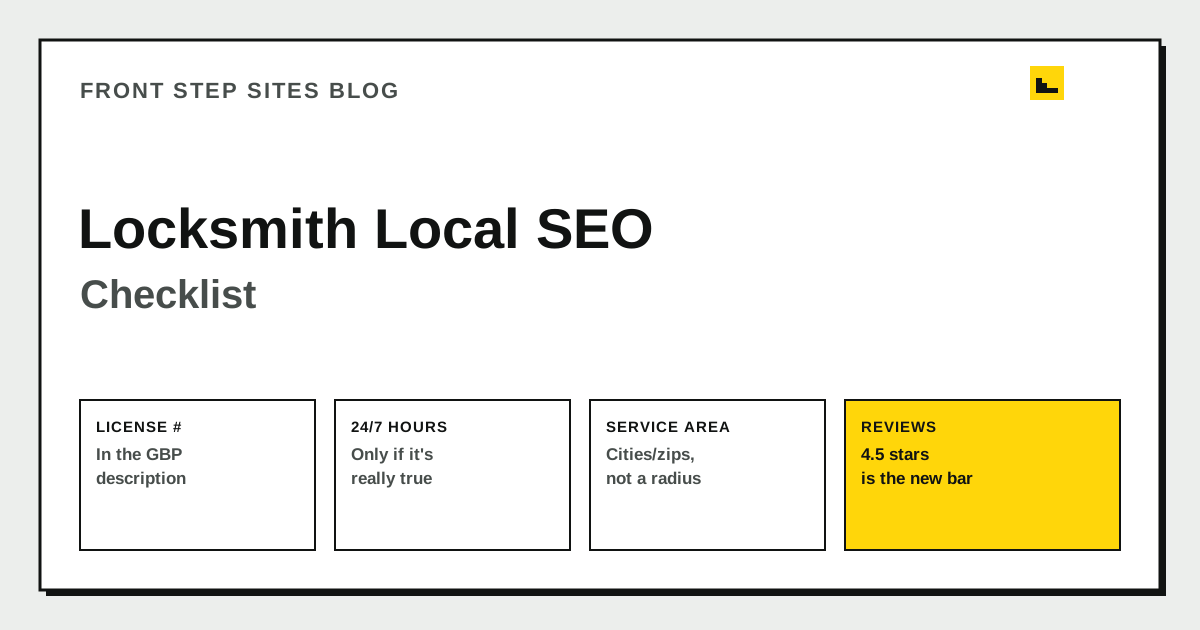
A locksmith local SEO checklist has to cover four things that generic trade checklists skip: where your license number goes, how you show emergency hours without overclaiming, how your service area is built, and how many reviews it actually takes to clear the star rating customers now screen for. A locked-out customer standing at their car at 11pm is deciding between listings in under a minute, so each of these needs to be right before anything else on a standard SEO checklist matters.
Is your license number visible where Google allows it?
Your state license number should sit in your Google Business Profile description, since Google has no dedicated license field for locksmiths, and again on your website where you have room to explain it. The locksmith Google Business Profile guide covers this placement in more depth if you haven't set the profile up yet. Not every state requires a locksmith license: 13 states currently do, including California, Texas, Illinois, and Virginia, according to BestKeySupply's 2026 state-by-state locksmith licensing guide. If your state is one of the 13, showing the number costs nothing and tells a nervous customer you're not running a scam. If your state doesn't require one, say so plainly rather than leaving the space blank and looking like you skipped a step.
Does your emergency availability match what you actually dispatch?
Write your hours and your "24/7" claims to match your real dispatch, not your aspiration. If overnight calls route through an answering service or an on-call rotation instead of a tech who picks up directly, say that with special hours rather than claiming full around-the-clock staffing. Mobile searches dominate this trade more than most. Over 70% of locksmith searches happen on a phone, according to LocalMighty's 2026 locksmith SEO guide, which means most of the people checking whether you're "open now" are standing outside, in the dark, deciding in seconds.
Is your service area a list of cities, not a radius?
Your service area needs to be a list of specific cities or zip codes, up to 20 of them, covering roughly two hours of driving time from your base. Google dropped the plain-radius option for service-area businesses, so a listing still showing a circle on a map is running on an outdated setup. Build the list from towns you actually reach quickly, not every zip within range on a straight line, since a locksmith who lists 20 towns but only answers fast within five of them earns exactly the review you don't want.
Do your service and location pages separate residential, automotive, and commercial work?
A locksmith's website should have a page for each core service, residential lockouts and rekeys, automotive key programming, and commercial access systems, rather than one page that mentions all three in passing. Someone locked out of a car is searching differently than someone who just moved into a new house, and a page that speaks directly to their situation converts better than a general "locksmith services" page trying to cover everyone at once. If you serve several towns, build out location-specific pages only where you have something real to say about that area, rather than swapping one city name into an otherwise identical page. The locksmith website cost guide covers what a site with that page structure typically runs across DIY, freelance, agency, and done-for-you options.
This checklist focuses on what's unique to locksmiths. The structure itself, service pages, location pages, and a review habit, follows the same shape as the local SEO checklist for auto repair shops, just with different specifics at each step.
Is your name, address, and phone number consistent everywhere?
Your business name, address if you have one, and phone number need to match exactly across your Google Business Profile, your website footer, and any directory listing you appear in. A phone number that's one digit off between your website and an old directory listing is the kind of thing that quietly costs calls for months before anyone notices. Check this quarterly, and immediately after any number or address change.
Do you have enough reviews to clear the bar customers actually use?
Review volume matters as much as the star rating itself, and the bar has moved. According to BrightLocal's 2026 Local Consumer Review Survey, 31% of consumers will only consider a business rated 4.5 stars or higher, up from 17% the year before, and 68% require at least 4 stars.
Here's what that means with real numbers. Say your profile sits at 40 reviews averaging 4.3 stars, a total of 172 stars across those reviews. To cross 4.5, you'd need:
(172 + 5x) / (40 + x) = 4.5
Solving for x gives 16. Sixteen new 5-star reviews move that profile from 4.3 to 4.5, assuming no new negative reviews land in between. That's roughly a review every two or three completed jobs over a few weeks for most single-truck locksmiths, which is a reachable target if you ask every satisfied customer rather than hoping the happy ones remember on their own.
| Checklist item | Generic trade advice | What's actually different for locksmiths |
|---|---|---|
| License number | Not usually relevant | Put it in the GBP description; required in 13 states |
| Hours | Match normal business hours | Must distinguish true 24/7 from on-call dispatch |
| Service area | List nearby towns | Build from cities/zips, not a radius, within ~2 hours |
| Reviews | More reviews help | Need enough volume to clear the 4.5-star threshold, not just a high average |
Frequently asked questions
Do I need a license number on my website if my state doesn't require one?
No, but it helps to say your state doesn't require locksmith licensing rather than leaving the topic untouched, since a customer who's used to seeing license numbers from other trades may wonder why yours is missing.
How many Google reviews does a locksmith actually need?
There's no fixed number, but the math above shows why volume matters alongside rating: a handful of reviews swings wildly with each new one, while 40 or more reviews gives your average enough stability to stay near 4.5 even if an occasional 3-star review lands.
Should every town I serve get its own page on my website?
Only if you have something specific to say about that town, like neighborhoods you cover or a real completed job there. A list of near-identical pages with the city name swapped reads as thin to both customers and Google.
What's the single biggest local SEO mistake locksmiths make?
Claiming 24/7 availability that doesn't match real dispatch. It shows up fast in reviews once a customer calls at 2am and nobody answers, and those reviews are hard to undo.
The short version
A locksmith local SEO checklist earns its keep by covering what's actually different about this trade: license placement, honest emergency hours, a properly built service area, and enough reviews to clear the 4.5-star bar most customers now use. Front Step Sites sets up local SEO as part of every $99-a-year site, domain included, with no setup fee.