What a Website Maker Does: A 12-Task Cost Example
A website maker is a tool, person, or service that turns business information into published web pages. Front Step Sites is a done-for-you website service for small businesses that handles the making and upkeep after the owner supplies accurate business facts.
By Logan Moore · Updated October 25, 2026
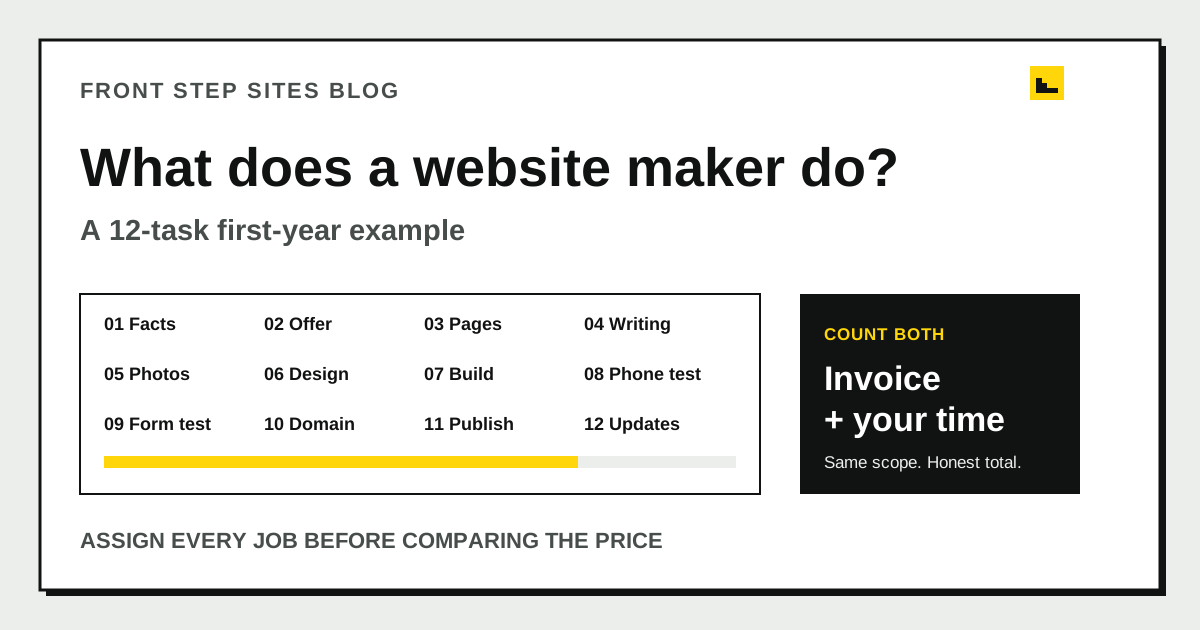
A website maker is a tool, person, or service that turns business information into published web pages. If you typed “website maker com,” read the exact web address before creating an account because the phrase does not identify one clear product. Compare the full job: collecting business facts, writing, building, testing, publishing, and making later updates.
What does a website maker actually do?
A website maker turns facts, words, images, and contact paths into public web pages. Software gives you controls for doing that work yourself. A done-for-you provider handles more of the work after you supply accurate information about the business.
The finished site still needs the same basic ingredients:
- A domain customers can recognize and the business controls
- Hosting that keeps the pages available
- Clear writing about services and coverage
- A layout that works on phones and larger screens
- Working calls, forms, booking links, or directions
- A process for correcting information later
The label “website maker” does not tell you which jobs are included. Ask who performs each task and who fixes it if the first version is wrong.
Why is “website maker com” an ambiguous search?
“Website maker com” is ambiguous because it could mean a website-making service, a specific domain someone remembers imperfectly, or a search for a .com business website. The safest next step is to read the full address in the browser and confirm the company name, plan terms, and renewal details before entering payment information.
A .com ending does not prove that a provider is established or that its pages will rank better. Google Search Central says a top-level domain such as .com or .org does not determine performance in Google Search. Google aims to return relevant results regardless of the top-level domain.
A .com can still be easier for a US customer to remember. Treat that as a naming choice, not evidence that the maker will write, test, or maintain a useful site.
What are the 12 jobs hidden inside a website build?
The 12 jobs hidden inside a small business website are fact collection, offer planning, page planning, writing, photo selection, design, building, phone testing, form testing, domain connection, publication, and updates. Some happen once. Others return whenever hours, prices, services, or staff change.
| Job | DIY website builder | Done-for-you service |
|---|---|---|
| 1. Collect business facts | Owner | Owner supplies, provider checks |
| 2. Choose the main offer | Owner | Shared decision |
| 3. Plan pages | Owner | Provider |
| 4. Write page text | Owner | Provider |
| 5. Choose real photos | Owner | Owner supplies, provider places |
| 6. Set the visual layout | Owner | Provider |
| 7. Build the pages | Owner | Provider |
| 8. Test phone layout | Owner | Provider, then owner checks |
| 9. Test calls and forms | Owner | Shared check |
| 10. Connect the domain | Owner | Provider with owner control |
| 11. Publish the site | Owner | Provider |
| 12. Make later changes | Owner | Depends on the plan |
Use this table to check the scope. A hands-on owner may prefer every DIY row. Another owner may prefer to spend that time on estimates, jobs, or customers.
What does a worked first-year example cost?
A worked first-year example should count both the invoice and the owner's time. Consider Riverbend Appliance Repair, a fictional one-person business with four service pages. The assumptions below are examples, so replace them with your own hours and value.
Riverbend values the owner’s working time at $35 an hour. The owner estimates 10.5 hours to plan, write, build, and test a DIY site, followed by 15 minutes a month for updates. That is 13.5 hours in the first year.
| First-year item | Example amount |
|---|---|
| DIY launch time | 10.5 hours |
| DIY updates | 3 hours |
| Total owner time | 13.5 hours |
| Time value at $35 per hour | $472.50 |
| Front Step Sites Launch plan | $99 per year |
| Owner time assumed for questionnaire and checks | 1.5 hours |
| Owner time value at $35 per hour | $52.50 |
| Done-for-you example total | $151.50 |
The difference in this example is $321 for year one before adding any DIY software or domain charge. The number changes if the owner enjoys the work, builds faster, values the time differently, or needs custom features. It also changes if the provider’s scope leaves writing or updates with the owner.
Front Step Sites states its Launch plan is $99 a year with the domain included and no setup fee. It includes four coherent marketing updates per Central calendar month. Over one year, that is capacity for 48 accepted updates if the owner uses all four each month. That named limit makes the maintenance row measurable.
For a subscription comparison across several years, use the separate three-year website cost check. The example here asks a different question: who handles the 12 jobs during one working year?
How should you value your own website time?
Value your own website time at the amount that reflects what the same hour could do in the business. A simple estimate uses your normal billable rate, contribution from an average job, or the hourly cost of the work you would otherwise pay someone to complete.
Put a dollar value on your time when website work replaces paid work. Some website hours will fall outside the workday. An evening spent learning a builder may be enjoyable and may not displace a customer job. Write down the assumption so the comparison remains honest.
Use this calculation:
- Estimate launch hours.
- Add expected update hours for one year.
- Multiply the total by your chosen hourly value.
- Add software, domain, paid templates, and outside help.
- Compare the total with a provider quote covering the same jobs.
The guide to website builders and done-for-you websites helps identify the responsibility differences before you fill in the numbers.
Which details should a website-maker quote include?
A website-maker quote should name the pages, writing, domain, hosting, contact features, testing, launch work, update process, renewal price, and exit terms. You cannot compare “complete website” with another offer because the phrase leaves the scope open.
Ask these questions in writing:
- Who writes the first draft?
- How many pages or distinct services are included?
- Who buys and controls the domain?
- What happens when the phone number changes?
- Are form submissions tested before launch?
- What renews, at what price, and on what schedule?
- What can the business take when it leaves?
Page count deserves context. The one-page versus multi-page website comparison explains when extra pages answer distinct customer questions and when they add upkeep without helping.
Frequently asked questions
Can Front Step Sites make my website for me?
Yes. Front Step Sites is a done-for-you website service for small businesses, rather than a self-serve builder. You supply accurate business facts and approve the result; the service writes, builds, publishes, and handles changes within the selected plan.
Is a website maker the same as a website developer?
Not always. “Website maker” often refers to a visual do-it-yourself tool, while a developer writes or configures code and integrations. A provider may use a builder, custom development, or both. Ask about the result and responsibilities rather than relying on the label.
Does a .com website rank better on Google?
Google says the top-level domain does not determine search performance. A clear .com may still be memorable for US customers. Useful pages, accurate business information, and a working site matter more than buying an address for a hoped-for ranking advantage.
How many update requests does the $99 plan include?
Front Step Sites Launch includes four coherent marketing updates per Central calendar month. That provides up to 48 accepted updates over 12 months if all four are used every month. Confirm what counts as one request before comparing it with an unlimited or pay-per-change offer.
Should I count my own time as a website cost?
Yes, count it if building the site replaces paid work, family time, or another task you value. Use a number you can explain and change it to see how sensitive the result is. A time estimate is a planning tool, not a universal wage.
The short version
A website maker handles tools, labor, or some combination of both. List the 12 jobs, assign each one, and price your own time before comparing offers. The cheapest subscription can become the expensive choice when the work remains unfinished, while a service is poor value when its scope excludes the work you expected.