How to create a small business website
Updated October 3, 2026
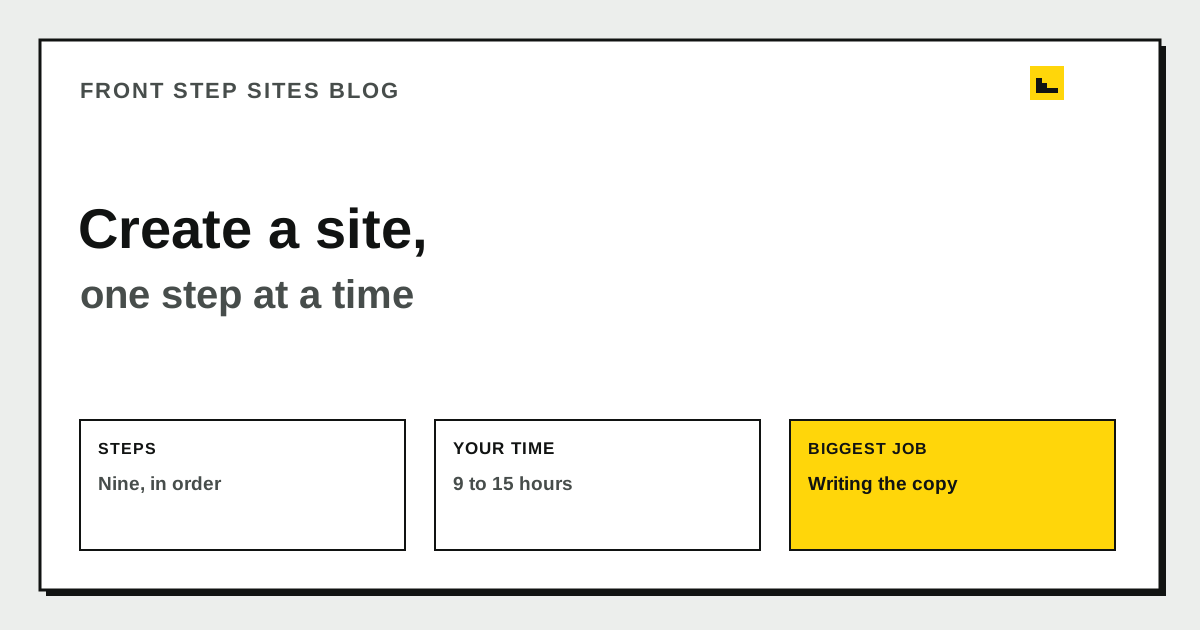
You want a website that tells customers who you are, what you do, and how to reach you. You don't need a designer to get there, but you do need an order of operations. Choose the builder first and you'll end up redoing work once you find out what the site has to say.
What are the steps, in order?
The table below lists nine steps. The times are my estimates for a small site of four to six pages, done by an owner who has never built one. Your times will vary with how fast you write.
| # | Step | Rough time | Who does it |
|---|---|---|---|
| 1 | Choose and register a domain | 30 minutes | You, in your name |
| 2 | Pick hosting, or a builder that includes it | 30 minutes | You |
| 3 | Decide on the pages: home, each service, about, contact | 1 hour | You |
| 4 | Write the copy for each page | 4 to 8 hours | You |
| 5 | Pick or shoot photos of your work and your team | 1 to 2 hours | You, with a phone |
| 6 | Add a contact form and your phone number | 30 minutes | You, or your builder |
| 7 | Link your Google Business Profile to the site | 30 minutes, plus any verification wait | You |
| 8 | Test on a phone, fix anything broken, then launch | 1 to 2 hours | You |
Add the middle of those ranges and you get about 9 to 15 hours of your own time. That total doesn't count the calendar days you spend waiting on photos, a reply, or a login.
Where does most of the time go?
Step 4 takes the longest, and it's the one owners underestimate. Blacksmith, a web design agency, puts it plainly: "content usually becomes the biggest bottleneck in website projects." Its timelines cover larger agency projects, where it estimates 2 to 4 weeks just to move text, images, and video into place. A five-page site is smaller than that, but the lesson holds. Write the words before you sign up for anything.
For each page, answer three questions in plain sentences. What do you do? Who is it for? What should the customer do next? A service page can be a few short paragraphs, a price range if you quote one, and a phone number.
Which step should come first?
Start with the domain, because it's the one piece you'll keep for good. Pick a name that matches your business, register it in your own name, and keep the login somewhere safe. The guide to choosing a domain name for a small business covers the choices that cause trouble later.
Then pick hosting. Hosting is the service that keeps your site online, and most builders include it. The plain-English explanation of website hosting helps you check that it's part of the plan you pick.
What goes on the contact page and the home page?
Your home page should answer three things within a few seconds: what you do, where you work, and how to reach you. Put your phone number near the top and your hours nearby. Your contact page can repeat those details with a form, a service-area list, and a note on how fast you reply.
Keep the name, address, and phone number identical to what's on your Google Business Profile. A mismatch makes it harder for search engines to connect the two.
Who should do each step?
Most owners can handle steps 1 through 5 and 8 alone. A builder can't write steps 3 and 4 for you, since only you know what you do. If you'd rather hand off steps 2 through 8, Front Step Sites builds and runs the site for $99 a year with the domain included, and you ask for changes in your account. Whatever you pick, you still supply the words and the photos.
What happens after launch?
Once the site is live, search engines and AI assistants read the same text you wrote. Specific pages do more for you than clever ones. The guide to GEO for small businesses explains how to write those pages so an assistant can quote them back to a customer.
Frequently asked questions
How long does it take to create a small business website?
For a DIY owner, expect roughly 9 to 15 hours of your own work, spread over however many weeks you can spare. Agency timelines run longer: Blacksmith quotes 4 to 12 weeks for the design phase alone on its projects, which are bigger than a small site.
Do I need a website if I already have a Google Business Profile?
In most cases, yes. A profile lists your name, hours, and phone number, but it doesn't give you a page for each service or a place to answer the questions customers ask before they call.
What does a small business website need at minimum?
A home page, one page for each main service, an about page, and a contact page with your phone number and a form. Add a Google Business Profile link and a domain you own. That's enough to launch, and you can add pages later.
The short version
Creating a small business website is nine steps: domain, hosting, pages, copy, photos, contact form, Google Business Profile link, then a phone test and launch. Plan on roughly 9 to 15 hours of your own time, and expect the copy to take the most. If you'd rather not run the steps yourself, Front Step Sites handles them for $99 a year, domain included.